Kitchen floor contractors serve a specific kind of project — and the kitchen makes different demands on a flooring installation than almost any other room in the home. The floor in a kitchen absorbs constant foot traffic, chair movement, dropped items, liquid spills, and grease exposure, all in a space where aesthetics matter as much as durability. In South Florida, sustained humidity and slab-based construction add installation variables that require a contractor who understands the region’s conditions before the first tile or plank goes down.
Nakamura Contractors Corp has completed more than 500 projects across the Treasure Coast and South Florida over 14+ years — including kitchen flooring installations as part of full kitchen remodels, standalone floor replacements, and commercial kitchen build-outs for restaurants and tenant spaces. The team installs hardwood, tile, and luxury vinyl plank (LVP), all under Florida contractor license CBC-1268079. Explore the full Flooring & Finishes service scope for residential and commercial projects across South Florida.
What Kitchen Floor Contractors Do — Why the Kitchen Is Different from Other Rooms
The role of kitchen floor contractors goes beyond delivering and installing a flooring material. Before installation begins, the subfloor must be assessed and prepared — leveled, dried, and treated based on the material being installed and the substrate underneath. An out-of-level subfloor under a tile installation will crack grout lines under repeated load. Improperly conditioned subfloor under engineered hardwood in a South Florida kitchen can produce gaps or cupping as humidity cycles through the seasons.
The kitchen has more transitions and material interactions than most other rooms. The floor must meet cabinet toe kicks precisely, integrate cleanly at the dishwasher and refrigerator cutouts, and connect to adjacent rooms through a threshold that accounts for material height differences. These transitions are detail-work problems that distinguish experienced kitchen floor contractors from generalist flooring installers who treat the kitchen the same as a bedroom or hallway.
South Florida’s predominantly slab-built residential stock introduces a specific installation variable: concrete doesn’t offer the same natural vapor barrier that a wood-framed crawl space floor does. Moisture can migrate upward through the slab, affecting the performance of any floor installed directly over it if the installation method doesn’t account for vapor at the slab interface. A kitchen floor contractor who knows South Florida’s construction will address this as part of standard preparation, not as an afterthought when a problem surfaces post-installation.
At Nakamura, flooring work is executed by the in-house team and a vetted subcontractor network — all licensed and insured — coordinated to integrate with any concurrent kitchen work rather than functioning as a disconnected trade.
Kitchen Flooring Materials — Hardwood, Tile, and LVP in South Florida Kitchens
The three most common kitchen flooring materials each perform differently in South Florida’s climate and construction context. Understanding the trade-offs before selecting a material is part of what experienced kitchen floor contractors bring to the first consultation.
Hardwood flooring is the most visually premium option in a kitchen but requires the most careful handling in South Florida. Solid hardwood expands and contracts with humidity, making it a risk in a kitchen with humidity swings and proximity to moisture sources. Engineered hardwood — a wood veneer over a dimensionally stable plywood core — is the better-performing option in South Florida kitchens, holding up better against the region’s humidity profile. Either option requires proper acclimatization before installation and a vapor-control strategy at the subfloor. When executed correctly, hardwood brings warmth and resale value that other kitchen floor materials don’t replicate.
Porcelain and ceramic tile remain the most moisture-resistant and durable kitchen flooring choice. Tile doesn’t warp, absorb spills, or react to Florida’s humidity, and large-format porcelain — increasingly common in South Florida kitchen renovations — minimizes grout lines and creates a cleaner surface that is easier to maintain under daily kitchen use. The trade-off is the harder surface underfoot and the higher installation cost relative to LVP, driven by subfloor prep, adhesive, and grouting labor.
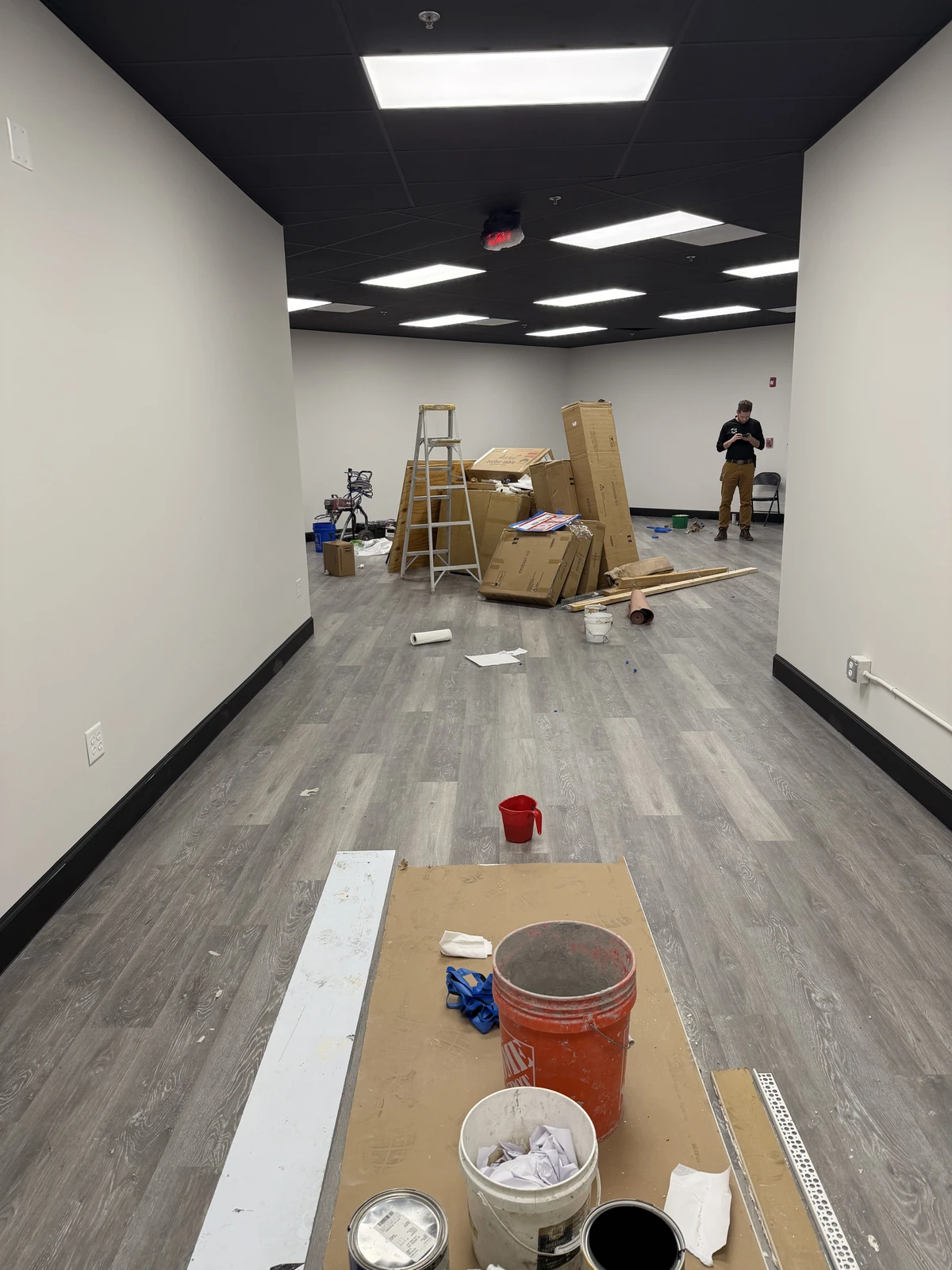
Luxury vinyl plank (LVP) has become the most frequently specified kitchen floor in South Florida residential work because it resolves most of the trade-offs in one material: 100% waterproof, compatible with slab subfloors without moisture barriers, comfortable underfoot compared to tile, and available in a wide range of finishes that read as hardwood or stone. LVP installs faster than tile and at a lower cost, making it the practical choice for most kitchen flooring budgets where hardwood or premium tile isn’t the priority.
Browse completed flooring examples in the project portfolio to see how each material type performs in finished South Florida kitchen installations.
Kitchen Floor Contractors for Commercial Projects — Restaurants, Kitchens, and Tenant Build-Outs
Commercial kitchen flooring is a different category from residential, and kitchen floor contractors who work in both markets bring a different level of preparation to restaurant and tenant build-out projects than residential-only flooring installers.
Commercial kitchen floors must perform under sustained high-traffic use, daily commercial cleaning protocols, and in many jurisdictions must meet health department requirements for slip resistance and surface cleanability. Material selection for commercial kitchen environments is driven by these requirements: durability, non-porosity, and resistance to commercial cleaning chemicals take precedence over aesthetic considerations that dominate residential selections. Coordinating the flooring scope with the mechanical, plumbing, and electrical trades — which all intersect in a commercial kitchen — requires a general contractor who manages the full build, not just the flooring trade in isolation.
Nakamura Contractors Corp provides commercial general contracting services for South Florida businesses — including ground-up restaurant construction, strategic remodeling of existing commercial kitchens, and tenant build-outs for new food service occupants. The commercial work commitment includes on-time and on-budget delivery, minimal disruption to ongoing business operations where applicable, and commercial-grade materials throughout. For business owners who need kitchen floor contractors who can coordinate the flooring within a full commercial construction scope, Nakamura handles it under one contract.
South Florida Kitchen Floor Considerations — Moisture, Subfloor, and Long-Term Performance
Kitchen floors installed in South Florida need to be specified with the region’s construction and climate conditions in mind from the start. Material choices that perform reliably in other markets can underperform in South Florida if the installation isn’t adapted to local conditions.
Moisture migration from concrete slab is the most common driver of kitchen flooring failure in South Florida homes. Concrete is porous, and humidity can move upward through a slab and into the flooring material above it — a problem that affects grout adhesion in tile, backing integrity in some LVP products, and wood expansion in hardwood floors. The correct response is a vapor control strategy at the subfloor interface, not a material selection that ignores the slab’s moisture profile. Experienced kitchen floor contractors in South Florida include this evaluation as part of site assessment before installation begins.
UV exposure from South Florida’s sun is a secondary material consideration that homeowners with south- or west-facing kitchens often overlook. Direct sustained sunlight through kitchen windows can affect the color stability of certain flooring finishes over time. LVP products with UV-stable top coats and hardwood floors with UV-resistant finishes handle this better than options without these specifications — a selection detail that experienced South Florida kitchen floor contractors can guide before the material order is placed.
All flooring work that is part of a permitted kitchen remodel is subject to Florida building code compliance and inspection. Nakamura Contractors Corp, licensed under CBC-1268079, manages the permit and inspection process as a standard part of every project scope that requires it — ensuring the flooring installation is documented and compliant at every stage.
Schedule a Free Estimate with South Florida Kitchen Floor Contractors — Nakamura Contractors
For homeowners and business owners in Port St. Lucie, Palm City, Jensen Beach, and Boynton Beach searching for kitchen floor contractors with a verified track record in South Florida, Nakamura Contractors Corp delivers the full kitchen flooring scope: subfloor assessment and preparation, material selection consultation, professional installation, and final finish — whether as a standalone flooring project or integrated into a broader kitchen remodel or commercial renovation.
Nakamura’s 14+ years of South Florida construction experience and 500+ completed residential and commercial projects reflect the workmanship standard applied to every flooring installation. Florida contractor license CBC-1268079 ensures all work is fully licensed and insured — the baseline credential that separates Nakamura from unlicensed flooring installers operating in the South Florida market.
Free estimates are available on all kitchen flooring projects. Browse the completed project portfolio for finished flooring examples across South Florida kitchens, review the full residential and commercial services, and connect through the contact page to schedule a consultation. Call (772) 278-1667 or email contact@nakamuracontractors.com.
Kitchen floor contractors who understand South Florida’s slab construction, humidity, and UV exposure bring a different preparation to the project — and that preparation is what the finished floor depends on.
Frequently Asked Questions
What do kitchen floor contractors do differently than general flooring installers?
Kitchen floor contractors account for the kitchen’s specific demands: higher moisture exposure than other rooms, grease and spill resistance requirements, transitions at cabinet bases and appliance cutouts, and subfloor conditions that may differ from adjacent rooms. In South Florida, this also means evaluating moisture migration from concrete slab construction and specifying the correct vapor-control approach before installation. At Nakamura Contractors, kitchen flooring work is coordinated with any concurrent kitchen work — cabinetry, plumbing, or remodel scope — so that trade sequencing doesn’t create conflict or delays in the installation timeline.
What is the best kitchen flooring material for South Florida homes?
Luxury vinyl plank (LVP) is currently the most commonly specified kitchen flooring in South Florida residential projects because it is 100% waterproof, compatible with slab subfloors, durable under daily kitchen use, and available in a wide range of hardwood- and stone-look finishes. Porcelain tile is the most moisture-resistant and durable option but has a harder feel underfoot and a higher installation cost. Engineered hardwood performs better than solid hardwood in South Florida’s humidity profile when kitchen hardwood is the aesthetic goal. The right material depends on the household’s budget, the existing subfloor conditions, and the aesthetic priority. Nakamura Contractors helps clients evaluate these trade-offs during the free estimate consultation.
Can Nakamura Contractors install kitchen flooring as part of a full kitchen remodel?
Yes. Nakamura Contractors handles kitchen flooring as part of full kitchen remodels — coordinating the flooring installation within the project sequence alongside cabinetry, countertops, painting, and any structural or mechanical work in the scope. This integrated approach means the flooring is installed at the right stage in the construction sequence, after cabinet installation is complete but before finish work, without the homeowner needing to coordinate a separate flooring contractor independently. Review the full kitchen and flooring services on the Services page or browse completed kitchen projects in the portfolio.
Does Nakamura Contractors do kitchen floor installation for commercial projects?
Yes. Nakamura Contractors provides commercial general contracting services for South Florida businesses, including kitchen flooring as part of restaurant construction, commercial kitchen remodeling, and tenant build-out projects. Commercial kitchen floors are subject to health department requirements for slip resistance and surface cleanability — requirements that affect material selection and installation method. Nakamura’s commercial team handles flooring within the full commercial construction scope, coordinating the flooring trade with mechanical, plumbing, and electrical work rather than managing it as a separate vendor relationship.
How do I get a free kitchen flooring estimate with Nakamura Contractors?
Call (772) 278-1667, email contact@nakamuracontractors.com, or submit a project inquiry through the contact page. Nakamura Contractors provides free estimates on all kitchen flooring projects — standalone floor replacements, kitchen remodel flooring scopes, and commercial kitchen flooring — serving homeowners and business owners across Port St. Lucie, Palm City, Jensen Beach, Boynton Beach, and the broader South Florida region. The estimate consultation includes a review of the existing kitchen floor conditions, material options, and subfloor considerations before any commitment is made.